
Are condos a good investment in 2026? Or is buying one a bad idea? There are advantages and disadvantages that should be weighed against each other.
Investing in a condo and turning it into a long term or short term rental property may seem like an alluring opportunity, but it’s imperative to recognize that it comes with both benefits and pain points that demand careful consideration.
This guide provides a comprehensive overview of everything you need to know about whether condos are a good investment, including tips on how best to approach such an endeavor successfully. We will also answer some frequently asked questions, so you’ll have the information necessary at hand when making your decision.
TL;DR
- Investing in condos for rental income can be a good idea as there are some benefits which include lower purchase prices, high-demand rental features, minimal external maintenance, and real estate appreciation.
- But there are some drawbacks to owning a condo like high homeowners association (HOA) fees and rental restrictions. And while condos do go up in value, it’s at a slower rate than other types of investment properties, like single family homes.
- To determine if a condo is a good investment for you, research your financing options and the local housing market, understand HOA rules and fees, and perform a rental property analysis using the appropriate data and tools.
Understanding Condos: Are Condos a Good Investment?
Yes, investing in condos can be beneficial for some real estate investors. Here are the main benefits:
Pros of Condo Investing
1. Lower Purchase Price
For many, investing in a condo is an appealing option due to the lower purchase price.
How much do condos cost?
Well, according to NAR, the median sales price for existing single family homes in 2025 was $419,500. For existing condos and co-ops, it was $363,600. That’s a difference of $55,900.
And because the property price is lower, investing in condos will generally come with lower taxes and monthly debt service, if an investor uses a loan to make the purchase.
Though dependent on other varying factors like location and expenses, this low barrier to entry can lead to more profit from rent, creating larger cash flow opportunities and a higher cash on cash return. This makes purchasing condominiums especially attractive for those just looking to acquire their first real estate investment and seasoned pros alike.
2. Attractive Rental Amenities
Most condos have amenities available for residents’ use that are funded by HOA fees. These could include grilling areas, gyms, pools, or other communal spaces designed with potential renters’ needs and desires in mind. Features such as these greatly help in attracting prospective tenants resulting in higher occupancy rates while also increasing your investment property’s overall value.
3. Minimal External Maintenance Responsibilities
Investing in condos has a significant appeal due to the minimal upkeep involved. Their exterior maintenance is taken care of by the homeowners association, inching investors closer toward generating passive income through rental properties. All investors have to do is pay the condo association fees.
Being able to avoid time-consuming property maintenance tasks allows condo owners to direct their attention toward servicing tenants and controlling cash flow.
Cons of Condo Investing
Investing in condos has potential drawbacks that you must also consider.
1. High Monthly Fees
When it comes to investing in a condo community, one potential drawback is the regular condo association fees that must be paid. These fees usually go towards:
- Maintenance & Repairs: Upkeep of shared spaces including landscaping, exterior painting, pool maintenance, and seasonal tasks like snow removal.
- Insurance: Property and liability coverage for all common areas and shared amenities.
- Utilities: Essential services such as water, wastewater, and trash removal.
- Security: On-site protection measures including security guards, gate systems, and surveillance cameras.
- Reserve Funds: A dedicated savings account for large-scale future repairs or emergency maintenance of community infrastructure.
Though the number varies by source, the national average is close to $290/month. However, these charges depend heavily on the location and size of the community as well as what they’re intended to cover. HOA fees can run up to $1000 in some higher-end areas and you have no control over them.
Though these payments help preserve your condos’ market value, they can also reduce your monthly rental earnings and affect overall cash flow too. It’s therefore important for investors to look at all expenses associated with any particular condo development when assessing their possible return on investment. This will help you maximize profits while minimizing risks along the way.
2. Rental Restrictions
Investing in a condo requires a careful review of the association’s bylaws and an understanding of its rental restrictions.
Condo associations could limit renters and have specific guidelines around certain exterior features such as paint color, decks, and parking. If you’re investing in a condominium to turn it into a short term rental, you need to make sure this is permissible under the HOA’s regulations.
Not following the HOA’s rules properly could lead to fines or legal action .
3. Slower Appreciation Potential
When deciding between a single family home and a condo investment, keep in mind that condos generally experience slower appreciation rates due to factors like low demand or association regulations and fees. In 2024, for example, NAR data shows that single family home prices rose by 6.1% while condo prices rose by 4.5%.
But the conditions of the condo community, as well as real estate market trends, can influence its market value growth. A condo in a dense urban area is usually in higher demand than a single family home, and in this example, would appreciate more in value.
Taking time for market research before settling on your choice is key to successful condominium investing. Make sure your decision makes sense from both short-term and long-term perspectives.
4. Poor Property Management by HOA
While not often the case, some HOAs may poorly manage condo complexes. From delayed repairs that call for a sudden increase in fees to ignored complaints or even nitpicky rules, you need to look for any red flags when buying a condo:
- Noisy neighbors
- Plumbing issues
- Odor issues
- Pest infestations
- Structural or maintenance issues
Be sure to inquire about the fees and maintenance schedule and ask the former condo owner or any current ones about the HOA management.
How to Determine If a Condo Is a Good Investment
After assessing both the pros and cons of buying a condo, you may decide that this is the right investment for you. But while condo investments may generally be a good idea, you need to find a specific condo for sale that will bring you a good return on investment.
This involves more than finding a nice condo. You have to answer a few questions like:
- Will you need financing? What can you expect when financing a condo?
- Are condo rentals in demand in the local market?
- Will the condo cash flow?
Let’s take a closer look at the process.
Financing Options
When it comes to financing a condo with a loan, there may be more stringent requirements than when acquiring a single family home. For instance, lenders might necessitate that the community should have at least some already-occupied units before they pre-approve your application. They could also ask for sound financial stability, higher down payments and interest rates, proof of condo insurance, or supplemental documents about the condominium complex, its HOA and the management.
If you’re looking into rental property loans to finance your condo investment, you must research your options thoroughly and work with an experienced lender. In the end, you need to make sure that your monthly payments don’t totally eat up your profits.
Location and Market Conditions
When investing in a property, the area and current housing conditions should be thoroughly looked into. It’s important to look at how attractive the location is likely to remain as well as its potential rate of appreciation. That way, you won’t have to worry about a low resale value. Assessing recent comparable sales for condos within that same building or complex can help you determine whether it’s worth purchasing. By gauging the rental property’s fair market value correctly, you will minimize your risk of overpaying.
And remember, HOA fees are tied to the location. Knowing the average HOA fee for the real estate market will ensure you don’t get roped into exorbitant prices – prices that will make it harder to resell to buyers down the road.
Besides property value and HOA fees, location also affects the demand for condo rentals. Condos are more popular among renters in major metropolitan areas and tech hubs. And if you plan on renting the condo out as an Airbnb, check the local laws. It may be prohibited or strictly regulated.
You can check local short term rental regulations anywhere in the US on Mashvisor.
By taking an informed approach when picking your condo investment option, you may see higher returns, improved occupancy levels, quicker turnover rates, and augmented cash flow from renters as well as a larger buyer pool when the time comes to sell. A wise evaluation combined with desirable local prospects will substantially boost any real estate investor’s chances of success.
Condo Investment Property Analysis
Once you know your budget and financing options and have narrowed down a location, it’s time to find a profitable condo. This requires running the numbers on a few different properties for sale.
Start by collecting data on basic expenses and taxes, average rental income in the area, and occupancy rates. A good resource for this info is Mashvisor. Then, figure out what your cash on cash return will be.
For more help on how to run the math, check out our guide: What Is Cash on Cash Return?
Generally, you want to aim for a condo that will produce a cash on cash return between 8% to 12%. A condo that can generate such returns will be a good rental investment.
Tips for Successful Condo Investing
Here are some useful tips on how you can make wise investments when dealing with condos and maximize their potential benefit.
Use Tools to Research the Real Estate Market
To find top-performing markets, use what the experts use: Mashvisor’s Market Finder. This tool can help you identify areas where you can gain the highest monthly profit from your rental property. Its proprietary neighborhood evaluation system, called the Mashmeter Score, shows which neighborhoods are worth investing in. Here’s how to use this tool:

Mashvisor’s Market Finder is the perfect tool for researching the local market to find a good condo investment.
How to Research the Local Market Using Mashvisor’s Market Finder
- On the Market Finder page, select your preferred rental strategy: short term or long term. And set the property type to Apartment/Condo.
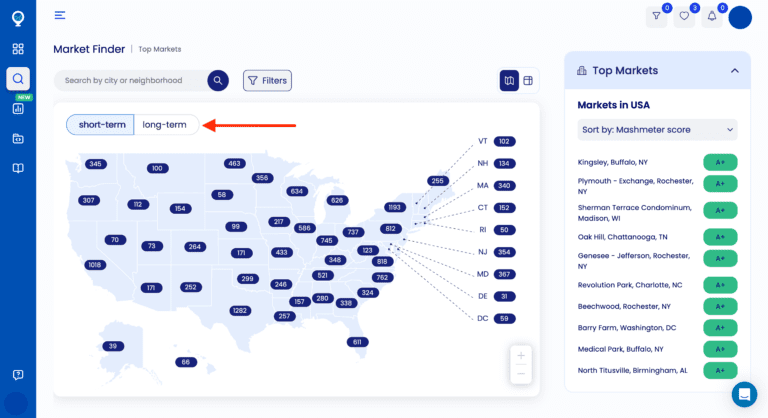
Select between “short term” and “long term” so you can configure the analysis based on your preferred rental strategy.
- Select the state that you wish to look into. You should be able to see names of several locations on the map as well as numbers in blue bubbles below them. These numbers correspond to the number of neighborhoods that you can analyze in that city. The Top Markets on the sidebar should also be showing the top neighborhoods in that state based on your chosen criteria (Mashmeter score, rental revenue, or cap rate).
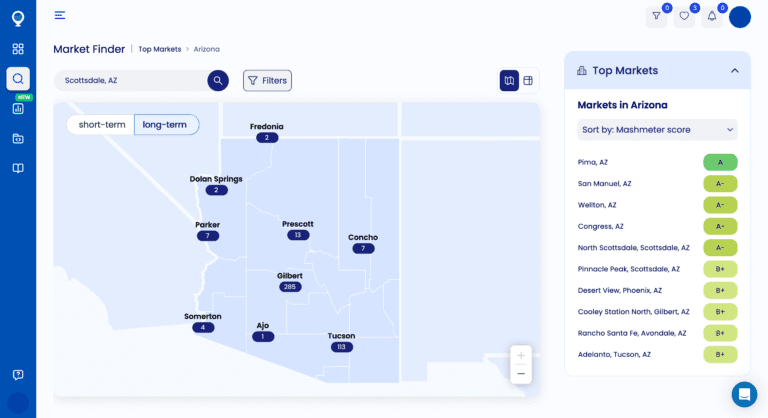
Aside from the map zooming into the state you choose, the Top Markets list on the side bar will only show the areas in that particular state as well.
- Click on the number of the corresponding area that interests you. You might have to select more numbers if the map is still covering a large area. Alternatively, you could also type in the city or neighborhood of your choice in the search bar above the map.
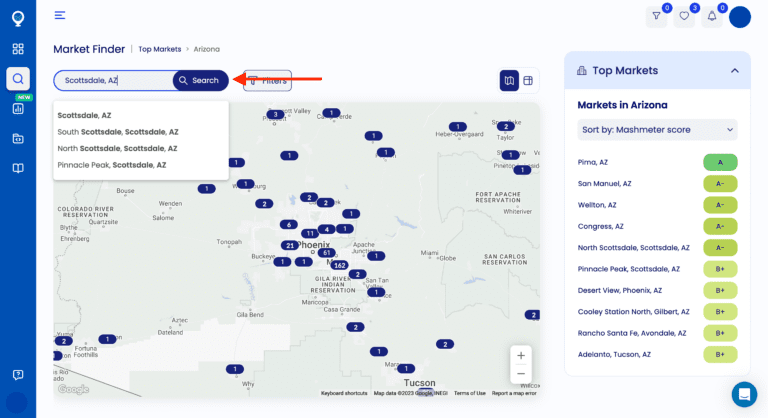
If you know what city or neighborhood you wish to look into, just type it in the search bar so that the map can zoom into that area.
- You’ll know you’ve zoomed furthest into the map once you see circles in shades of red or green. These colors indicate the Mashmeter score of that area. Clicking on a circle will open that neighborhood’s details on the sidebar. You can use the information there to help you determine whether the area is worth investing in.
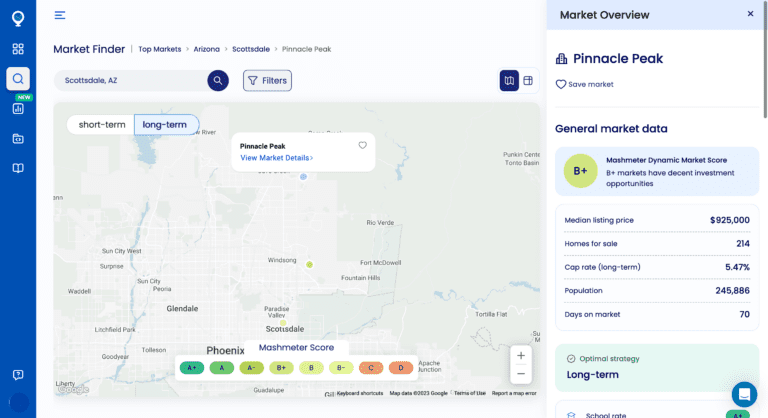
Clicking one of the circles on the map will display our real-time analysis for the selected neighborhood.
Don’t Run Manual Calculations on Condos
If you managed to find a location where condos are worth buying, they will probably be going fast. You don’t want to miss out on deals while you’re gathering data and doing the math for rental property analysis. So once again, the best tip for investing in condos is to use the tools available to you. One such tool is Mashvisor’s Rental Property Calculator.
Once you identify a location using the Market Finder, you can click on View Properties to see all the available listings there. Besides basic info, each property will have additional stats produced by the Rental Property Calculator including estimated expenses, rental income, cash on cash return, cap rate, occupancy rate and more for both rental strategies (Airbnb and long-term rentals).
Work with a Real Estate Agent
When investing in a condo unit, the help of a competent realtor who knows their way around the local condo market can be invaluable. An experienced professional will assist you throughout the entire process, from finding ideal listings to keeping up with market fluctuations and negotiating advantageous terms for your purchase. Plus, they’ll make sure that you’re paying an appropriate rate for any condo.
Summary: Are Condos a Good Investment?
If you are considering a condo investment, proper research is essential for reaping the rewards of this venture. It can be beneficial to collaborate with an experienced realtor and become aware of all HOA regulations that come along with owning such a property.
Understanding the advantages and disadvantages involved will help guide you on your path toward generating income through rental properties. All in all, if done correctly, investing in condos in 2026 could prove highly lucrative.
To learn more about how Mashvisor can help you find the best condos to invest in, sign up for a 7-day free trial now, followed by 15% off for life.
Frequently Asked Questions
Do condos hold their value?
Yes, condos typically retain their value over time. And although they appreciate at a slower rate than single family homes, their value is likely to increase as well.
Is it financially smart to buy a condo?
It can be financially beneficial to buy a condo as you’ll benefit from equity and rental income. Just be sure to run the numbers before making a purchase.
What are the disadvantages of a condo?
One major disadvantage of owning a condo is homeowner association (HOA) fees. These condo fees are required for the upkeep of shared areas and can run high for some communities.
Why are condos a good investment?
Condos are good investments because you will gain equity as you pay off your mortgage and in the right area, they can produce cash flow and high returns when rented out.
What are the main advantages of investing in a condo?
For those looking to invest, condos have the benefit of having lower purchase prices than single family homes. They also offer desirable amenities such as swimming pools, fitness centers, and communal areas that can provide recreational activities. Owning a condo means fewer external maintenance responsibilities compared to other properties, which makes it an appealing option for potential investors.